Handler & Pipeline
ChannelHandler 用来处理 Channel 上的各种事件,分为入站、出站两种。所有 ChannelHandler 被连成一串,就是 Pipeline
- 入站处理器通常是 ChannelInboundHandlerAdapter 的子类,主要用来读取客户端数据,写回结果
- 出站处理器通常是 ChannelOutboundHandlerAdapter 的子类,主要对写回结果进行加工
打个比喻,每个 Channel 是一个产品的加工车间,Pipeline 是车间中的流水线,ChannelHandler 就是流水线上的各道工序,而后面要讲的 ByteBuf 是原材料,经过很多工序的加工:先经过一道道入站工序,再经过一道道出站工序最终变成产品
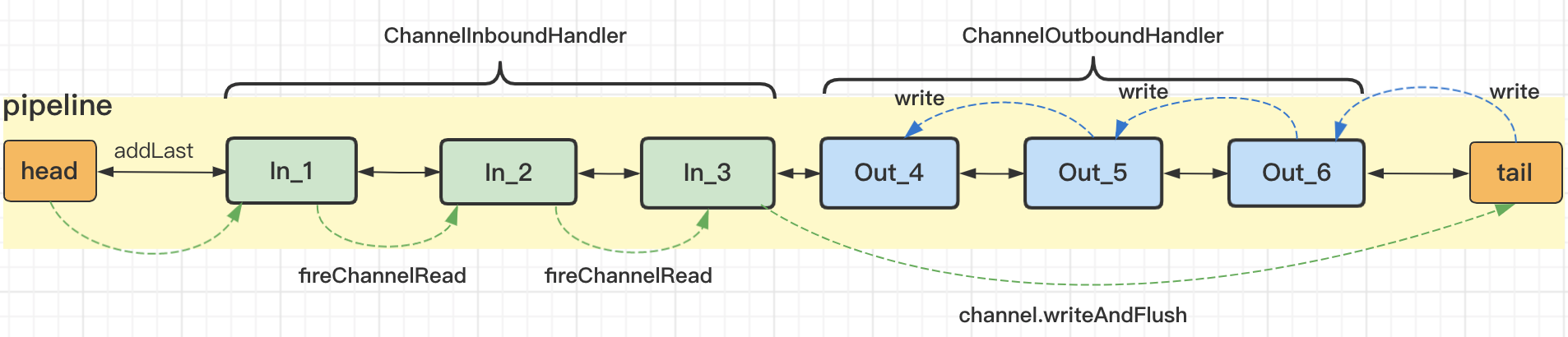
ChannelInboundHandlerAdapter 是按照 addLast 的顺序执行的,而 ChannelOutboundHandlerAdapter 是按照 addLast 的逆序执行的。
ChannelPipeline 的实现是一个 ChannelHandlerContext(包装了 ChannelHandler) 组成的双向链表
ChannelHandlerContext的之间是双向链表,如果有写出操作,则出站处理器是按addLast逆序执行。
public class DefaultChannelPipeline implements ChannelPipeline {
// head 和tail final AbstractChannelHandlerContext head; final AbstractChannelHandlerContext tail;
private final Channel channel; private final ChannelFuture succeededFuture;
// addLast private void addLast0(AbstractChannelHandlerContext newCtx) { AbstractChannelHandlerContext prev = tail.prev; newCtx.prev = prev; newCtx.next = tail; prev.next = newCtx; tail.prev = newCtx; }
}
演示:
后续说明以h1、h2、h3都作为入站处理器、而h4、h5、h6都作为出站处理器
在每个不是最后的入站处理器中,我们必须调用channelRead方法,否则链就断了。
在重写的方法里,如果不调用 super.channelRead(...) 或 ctx.fireChannelRead(...),事件就会在此处拦截,后续的 Handler 将不会收到该事件
在handler-3,也就是最后一个入站处理器的方法中,不需要再调用super.channelRead(),因为后面没有入站处理器了。直接调用写出的方法
/** * @Author: yakiniku * @Date: created on 2021/12/5 02:13 */@Slf4jpublic class TestPipeLine { public static void main(String[] args) { new ServerBootstrap() .group(new NioEventLoopGroup()) .channel(NioServerSocketChannel.class) .childHandler(new ChannelInitializer<NioSocketChannel>() { @Override protected void initChannel(NioSocketChannel ch) throws Exception { // 通过channel拿到pipeline ChannelPipeline pipeline = ch.pipeline(); // 添加处理器 netty会默认有两个head 和tail // head -> h1 -> h2-> h3->... -> tail // head -> h1 -> h2-> h3-> out-h4-> h5 -> h6.... -> tail pipeline.addLast("handler-1",new ChannelInboundHandlerAdapter(){ @Override public void channelRead(ChannelHandlerContext ctx, Object msg) throws Exception { log.debug("1"); ByteBuf buf = (ByteBuf) msg; String name = buf.toString(Charset.defaultCharset()); super.channelRead(ctx, name); } }); pipeline.addLast("handler-2",new ChannelInboundHandlerAdapter(){ @Override public void channelRead(ChannelHandlerContext ctx, Object msg) throws Exception { log.debug("2"); String name = (String) msg; Student student = new Student(name); super.channelRead(ctx, student); } }); pipeline.addLast("handler-3",new ChannelInboundHandlerAdapter(){ @Override public void channelRead(ChannelHandlerContext ctx, Object msg) throws Exception { log.debug("3,结果{},class{}",msg,msg.getClass());
//不需要继续调用super.channelRead ,因为后面没有入站处理器了。// super.channelRead(ctx, msg);// ch.writeAndFlush("test"); //这条收不到= = 但是Outbound里的都会执行到 ch.writeAndFlush(ctx.alloc().buffer().writeBytes("server..".getBytes())); } }); pipeline.addLast("handler-4",new ChannelOutboundHandlerAdapter(){
@Override public void write(ChannelHandlerContext ctx, Object msg, ChannelPromise promise) throws Exception { log.debug("4"); super.write(ctx, msg, promise); } }); pipeline.addLast("handler-5",new ChannelOutboundHandlerAdapter(){
@Override public void write(ChannelHandlerContext ctx, Object msg, ChannelPromise promise) throws Exception { log.debug("5"); super.write(ctx, msg, promise); } }); pipeline.addLast("handler-6",new ChannelOutboundHandlerAdapter(){
@Override public void write(ChannelHandlerContext ctx, Object msg, ChannelPromise promise) throws Exception { log.debug("6"); super.write(ctx, msg, promise); } }); } }) .bind(9070); }
@Data @AllArgsConstructor static class Student{ private String name;
}}22:06:26.742 [nioEventLoopGroup-2-2] DEBUG com.yakiniku.netty.c4.TestPipeLine - 122:06:26.748 [nioEventLoopGroup-2-2] DEBUG com.yakiniku.netty.c4.TestPipeLine - 222:06:26.749 [nioEventLoopGroup-2-2] DEBUG com.yakiniku.netty.c4.TestPipeLine - 3,结果TestPipeLine.Student(name=小明),classclass com.yakiniku.netty.c4.TestPipeLine$Student22:06:26.750 [nioEventLoopGroup-2-2] DEBUG com.yakiniku.netty.c4.TestPipeLine - 622:06:26.750 [nioEventLoopGroup-2-2] DEBUG com.yakiniku.netty.c4.TestPipeLine - 522:06:26.750 [nioEventLoopGroup-2-2] DEBUG com.yakiniku.netty.c4.TestPipeLine - 4channel的writeAndFlush的方法和直接调用channelHandlerContext的writeAndFlush方法有什么不同?
首先,如果在入站处理器调用channel.writeAndFlush(),实际上会从tail开始往前调用出站处理器
@Override public final ChannelFuture writeAndFlush(Object msg) { return tail.writeAndFlush(msg); }而如果直接调用ctx.writeAndFlush(),则是直接从当前handler往前找出站处理器。
channel : h1→h2→h3→tail→h6→h5→h4
ctx : h1→h2→h3
如果一开始的顺序是: h1←→h2←→h4←→h3←→h5←→h6,那么
ctx :h1→h2→h3→h4
EmbeddedChannel
EmbeddedChannel 是 Netty 提供的一个专门用于测试和在无网络传输环境下运行 ChannelHandler/Pipeline 的特殊 Channel 实现。
它把原本依赖真实底层网络 I/O(如 TCP Socket、NIO 等)的异步事件流,封装到了内存中的队列中,
允许开发者以同步、可控的方式模拟入站(Inbound)和出站(Outbound)的数据收发。
核心应用场景
- 单元测试自定义Handler,如测试自定义编码器解码器,协议解析,加解密,业务处理Handler等,无需启动真实的Socket服务端或客户端
- 免端口、轻量级运行
/** * @Author: yakiniku * @Date: created on 2021/12/5 22:38 */@Slf4jpublic class TestEmbeddedChannel { public static void main(String[] args) { ChannelInboundHandlerAdapter h1 = new ChannelInboundHandlerAdapter() { @Override public void channelRead(ChannelHandlerContext ctx, Object msg) throws Exception { log.debug("1"); super.channelRead(ctx,msg); } }; ChannelInboundHandlerAdapter h2 = new ChannelInboundHandlerAdapter() { @Override public void channelRead(ChannelHandlerContext ctx, Object msg) throws Exception { log.debug("2"); super.channelRead(ctx, msg); } }; ChannelOutboundHandlerAdapter h3 = new ChannelOutboundHandlerAdapter(){ @Override public void write(ChannelHandlerContext ctx, Object msg, ChannelPromise promise) throws Exception { log.debug("3"); super.write(ctx, msg, promise); } };
ChannelOutboundHandlerAdapter h4 = new ChannelOutboundHandlerAdapter(){ @Override public void write(ChannelHandlerContext ctx, Object msg, ChannelPromise promise) throws Exception { log.debug("4"); super.write(ctx, msg, promise); } };
EmbeddedChannel embeddedChannel = new EmbeddedChannel(h1, h2, h3, h4); //模拟入站操作 embeddedChannel.writeInbound(ByteBufAllocator.DEFAULT.buffer().writeBytes("hello".getBytes())); embeddedChannel.writeOutbound(ByteBufAllocator.DEFAULT.buffer().writeBytes("world".getBytes()));
}}22:52:11.116 [main] DEBUG c.y.netty.c4.TestEmbeddedChannel - 122:52:11.118 [main] DEBUG c.y.netty.c4.TestEmbeddedChannel - 222:52:11.120 [main] DEBUG c.y.netty.c4.TestEmbeddedChannel - 422:52:11.120 [main] DEBUG c.y.netty.c4.TestEmbeddedChannel - 3异常捕获机制
在复杂的Pipeline中,如果某个Handler抛出了异常,这个异常会沿着Pipeline顺次向后传播,直到被某个实现了exceptionCaught方法的Handler捕获。
最佳实践:通常在Pipeline的最后一个Handler(紧挨着tail之前)实现统一的异常处理逻辑(如打印日志、关闭连接、向客户端写回错误码)。如果在中途的 Handler 捕获了异常但没有向后传递,或者没有做任何处理,可能会导致异常被吞掉或连接无法正常释放。
演示代码
public class EmbeddedChannelDemo { private static final Logger log = Logger.getLogger(EmbeddedChannelDemo.class.getName());
public static void main(String[] args) {
ChannelInboundHandlerAdapter h1 = new ChannelInboundHandlerAdapter(){ @Override public void channelRead(ChannelHandlerContext ctx, Object msg) throws Exception { log.info("h1"); super.channelRead(ctx, msg); } }; ChannelInboundHandlerAdapter h2 = new ChannelInboundHandlerAdapter(){ @Override public void channelRead(ChannelHandlerContext ctx, Object msg) throws Exception { log.info("h2"); // 这里触发一个除零异常 int i = 1/0; super.channelRead(ctx, msg); } }; ChannelInboundHandlerAdapter h3 = new ChannelInboundHandlerAdapter(){ @Override public void channelRead(ChannelHandlerContext ctx, Object msg) throws Exception { log.info("h3"); super.channelRead(ctx, msg); } public void exceptionCaught(ChannelHandlerContext ctx, Throwable cause) throws Exception { log.info("捕获到异常: "+cause.getMessage()); } };
EmbeddedChannel embeddedChannel = new EmbeddedChannel(h1, h2, h3); embeddedChannel.writeInbound(ByteBufAllocator.DEFAULT.buffer().writeBytes("hello".getBytes())); }}